History of Deane
The
Old Parish of Dean
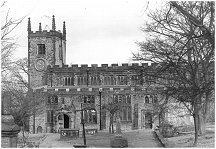
Deane Church
The
name Deane has been spelt in several ways including Dean, Dene, Deene and Deen. It has a Saxon origin and is derived from the word denu
meaning valley. Eventually Dean (as
it was spelt) was created a Parish in its own right; it was extremely large and
was subdivided into ten townships for ease of administration.
These townships were Farnworth, Little Hulton, Horwich, Kearsley,
Westhoughton, Heaton, Middle Hulton, Over Hulton, Halliwell and Rumworth, 1 ¾
miles south west of Bolton.
The
Croal, Bolton’s principal river, is in its higher reaches in Deane, where it
is called Middlebrook-Croal-Irwell watercourse.
The name Middlebrook is thought to come from the Old English words mycel
and broc meaning great brook which was written Mikelbrok in 1292.
There
was a Chapel in Dean called St. Mariden, or the Chapel of St. Mary, Dean and the
present Parish Church was built on the site of the original chapel in 1452. The earliest record of a Chapel in Dean was in the year
1100 and this was most likely a Saxon building.
It is from this chapel that the small stream running west of the present
church took its Saxon name Kirkebroke meaning Church Brook.
Sanitary
Conditions and Death Rate
Below
is an extract from a report by Dr. Ballard after he visited the area in October
1871. This report, which covered
all of Bolton and the surrounding districts, was made in order to investigate
the reasons for the abnormally high death rate in the area.
“The
village of Dean is undrained with
sewage running down the sides of the streets and roadways.
Some people live in unventilated cellar dwellings…. The privies and
ashpits are loaded and some of the yards of houses are disgustingly filthy.
The water supply of the cottages consists of shallow spring wells by the
roadside which are easily contaminated, and there are all kinds of rubbish in
them. In Green’s Fold, near the
vicarage, there have been many cases of fever.”
The
rate of infant mortality was much higher in Lancashire generally than in many
other areas although, out of all the industrial towns in Lancashire Bolton was
better than some, it still had an abnormally high death rate as shown by the
figures below.
Deaths
of Children Under 1 Year for Every 1000 Births Registered. C.1870
| Town | Child Deaths |
| Bolton | 176 |
| Salford | 199 |
| Manchester | 187 |
| Preston | 241 |
| 71 other towns | 164 |
(Source:
Dr. Ballard’s Report on the sanitary Conditions of Bolton.)
These high
death rates in babies were due to a combination of factors; general ignorance of
diet and cleanliness, unsanitary conditions, poor diet and neglect due to the
parents having to work long hours in the factories.
Not only did children die of the usual childhood diseases, but they died
of wasting diseases associated with vitamin deficiencies, such as rickets which
softens bones and is associated with vitamin D deficiency.
Gate
Pike and Pikes Lane
During the 18th
and 19th Centuries the area of Deane lying at the foot of the hill
called Deane Brow was known as ‘Gate Pike’.
The name ‘Gate Pike’ may have derived from the turnpike road which
was the old road which led up to Deane; the ‘Gate’ may come from the toll
bar, which was literally a gate at which tolls were paid by those wishing to use
the road. This toll bar was
situated near what is now Haslam Park.
From
Britannia Hotel, at the bottom of Deane Road, as far as Cannon Street, the road
used to be known as Blackburn Street, and from that point to the bottom of Deane
Brow, just beyond where Saviour’s Church once stood, it was Pikes Lane, hence
the name of the school. Around 1892
Blackburn Street and Pikes Lane became Deane Road.
The principal
means of subsistence in Gate Pike was hand loom weaving and few houses were
without at least one loom. The
cotton trade was established in cottages using handlooms in the 1600’s and
1700’s. Wool was the main textile
at the time but traders called ‘chapmen’ began to buy cotton and distribute
it to spinners and weavers by packhorse. The cotton trade prospered and in 1839, Dean Parish, which
covered a large area, had 16 cotton mills, which were mainly worked by steam
engines.
The Gate Pike
area had a terrible reputation for gambling and drinking and it came to be known
as “Hell’s Mouth.” Holidays
were generally spent racing, pigeon flying, and poaching or at local boxing and
wrestling matches. The
village, as it then was, nestled at the foot of the brow and a winding lane,
hedged on either side with hawthorns, ran from the centre of Bolton to the
ancient church of St. Mary’s, Deane. On
the left hand side of the road coming from town were pretty little white-washed
cottages with thatched roofs and roses round the doors.
Gate Pike was
once famous for its association with Pikes Lane football ground, the former
ground of Bolton Wanderers, where the club grew until it moved to Burnden Park
in 1895. The name Gate Pike has
fallen into disuse as the district is not separate as it use to be.
The country lanes have gone long ago and the area has been transformed
from what it once was.
Deane
Road and Wigan Road
Wigan Road is the continuation of Deane Road from the point marked by Blackshaw Lane which is a street off Deane Road. Deane toll bar was erected in 1800 about 50 yards below the vicarage gates and the tolls collected there were to contribute to the upkeep of the road. This toll was closed on 31st October 1878.