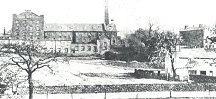
HANDLOOM WEAVERS AND THE
COTTON INDUSTRY
Wilderswood
Mill (1904)
Cotton spinning and bleaching were introduced
to the small hamlet of Horwich as early as the sixteenth century.
There was plentiful supply of water from the many streams descending from
the hills. This was of particular
importance in the bleaching process.
Textile machinery and steam power changed the
production of cotton from a home industry to a factory industry.
Many of the towns near Horwich, for example Bolton, Blackburn and
Manchester developed rapidly during the industrial revolution but Horwich never
developed into a ‘cotton town’. A
number of bleach works were located in the Horwich area; Longworth Mill along
Bridge Street, Foxhole Mill, Wilderswood and Wallsuches owned by the influential
Ridgway Family.
Although cotton spinning and bleaching became
a factory industry handloom weaving in the home continued well into the
nineteenth century. Handloom
weaving was a common employment in Horwich.
Most cottages possessed one or more pairs of looms.
In some families it was the sole way of earning a living but in many the
wife and children would do the weaving while the husband found employment
outside the home. The owners of the
bleach works would employ many of the weavers as ‘out workers’ bringing the
spun cotton to the home and taking the ‘bolts’ of material away by cart.
Weavers were regarded as skilled craftsmen and
as such could demand a high price for their cloth.
Whilst the cotton spinners and other factory workers were paid low wages
and worked long hours in dangerous and unpleasant conditions the handloom
weavers still enjoyed a more pleasant and more rewarding lifestyle very little
different from the rural life of past generations.
Most weavers would have owned their own
cottages and looms. Weavers’
cottages were amongst the most expensive working men cottages and the largest. In Georgian times they would have cost between £45 and £200.
The loomshop, where the weaver’s looms were kept was larger than the
other rooms in the house and let more natural light through the long rows of
windows. The windows were usually
triple ones, the more prosperous houses having separate windows approximately
one metre wide and one metre thirty centimetres apart.
In some areas of the country the loomshops were located on the upper
storey of the cottage but in central and North East Lancashire they would be on
the ground floor or cellar area. Club
houses in Horwich are a particularly fine example of weaver’s cottages with
cellar loomshops. The original
windows in these cottages were mullions, approximately forty-six centimetres
apart.
Humid conditions were required in the
loomshops to keep the thread supple and so reduce the number of breaks in the
thread. It was always damper below
ground level and this is probably why loomshops were placed in the cellars.
“The old English hand-loom weaver in the
cotton trade, in order to get the advantage of a base earth floor, preferred to
place his loom on a ground floor or in a cellar to an upper room, and often dug
a hole beneath his treddles, into which he passed water.
The evaporation from this kept his warp in the best condition for
weaving.” Cotton Weaving: Its Development, Principles and Practice
(London 1895) R. Marsden.
The weavers worked with animal and vegetable
fibres but mainly produced cotton cloth particularly calico.
To weave cotton successfully the warp threads required sizing.
The size was made from boiling wheat flour and potatoes.
By brushing the mixture on to the warps in the rear part of the loom the
fibres would all lie in the same direction and facilitate the movement of the
threads during the weaving process. The
threads would then be dried by means of a fan or moving a hot iron rod
underneath the loom. If they were
left too long the threads would become brittle and hard.
The damp conditions in the cellars helped to prevent this happening but
it was also found necessary to put further additives to the size to make it
easier to work. In the
mid-eighteenth century fish and beef brine were added.
Human urine was also used as an additive; when the weaving process
transferred to the factories it was very common for pots of urine to be bought
from the cottage folk at one penny per pot.
In the 1820’s the comfortable living of the
handloom weavers was finally threatened. Steam
looms came into general use and were installed in the factories. The cloth could now be produced much faster and cheaper.
There was no longer a demand for the cloth woven on the handloom.
By 1829 there was great hardship and distress among the handloom weavers,
not least in the community in Horwich. Factories
were pillaged and machinery destroyed in many areas. At Wallsuches a cannon was mounted overlooking the entrance
to the works. It was placed there
to deter any would be rioters. The
handloom weavers finally admitted defeat, as their companions in cotton spinning
had done some thirty to forty years before.
Weaving was no longer a cottage industry but part of the factory process.
The demise of the handloom meant a change of lifestyle for the workers
and their families. The relaxed,
independent, hardworking life within the family home was replaced by a much
harder life in the factories. The
hours were long, the wages low and their work was continually supervised by
overseers.
But the greatest impact must have been on the
structure of family life. For
centuries the children were brought up with a mother and father always near to
instruct them in the various skills of life.
It was common for children to help the parents with the household chores
and the work, whether it be spinning, weaving or farming.
A very close family bond was built up and there was no great divide
between work and play. This style
of life was destroyed when work moved away from the home.
The consequences of such an enormous change are still with us today.